Tag Archives: Kauai

The Lovely Laysan 2/10/15

The Laysan Albatross or Moli is truly an amazing bird. Well actually, I find all birds pretty cool, but the albatross I find particularly intriguing. Here at Ali’i Kai, I’m seeing these beautiful birds fly by every day as they fish on the water and catch the wind currents coming up the cliffs. They are basically built like sailplanes and spend most of their lives, for years at a time, 1,600 miles away on the open ocean in the North Pacific. The Princeville and Kilauea areas of Kauai are particularly blessed because the Laysan Albatross return each year to nest above the cliffs. This gives people like me the opportunity to see them up close as they sit on their eggs and tend to their chicks.

Photographing these birds in flight is not an easy task but I have managed to get a few good shots that thrilled me. At Kilauea Lighthouse/National Wildlife Refuge these birds as well as the Red-footed Booby and Great Frigatebird fly by quickly, riding the air currents rising from the ocean. My friend Jody who works at the Refuge showed me the best spot to stand to get a good shot at catching them as they soar by.
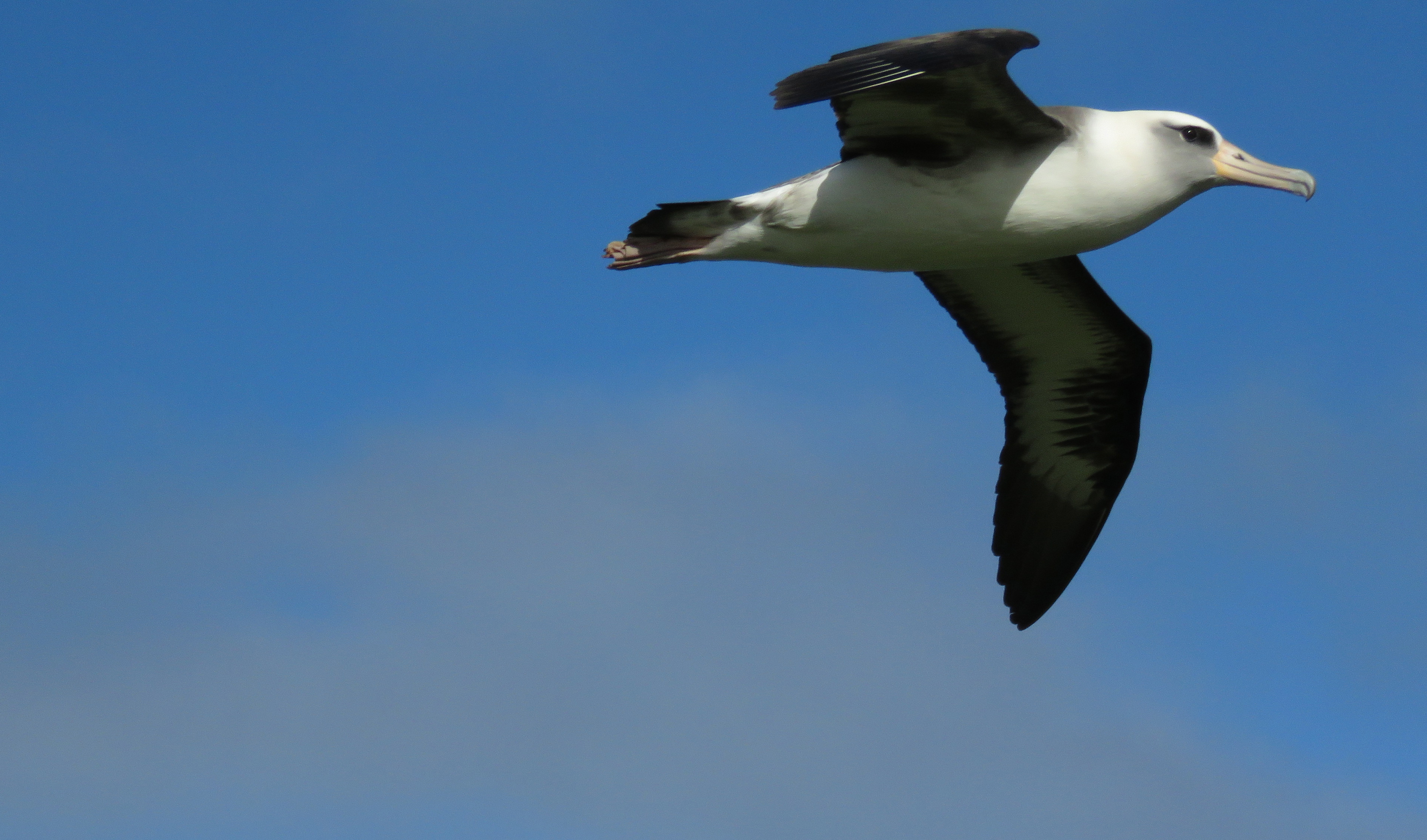
Laysan Albatross, Kilauea National Wildlife Refuge, Kauai

Laysan Albatross, Kilauea National Wildlife Refuge, Kauai

The Laysan’s body is 31-32” long and its wingspan is 78-80” – that’s over 6 ½ feet! Long, thin and pointed, their wings are built for seemingly effortless soaring over long distances. When you see them from a distance, what you notice is their large white body and dark wings. These birds feed primarily on cephalopods (mostly squid). On land, the albatross is pretty clumsy and walks with a humorous waddle – sort of like a toddler with a big diaper! Due to the their silly way on land, people used to call them “gooney birds.” Laysan Albatrosses vocalize with a collection of whinnies, wines and moans. They also snap their bills together a fair amount.

Our friend Jody knows a volunteer researcher, Cathy Granholm http://www.albatrossdiary.com who is protecting and recording the behaviors of the albatrosses while they nest and fledge in Princeville. Jody and two of her friends invited Bill and I to join Cathy on Friday as she made her rounds. This was a wonderful opportunity to see these birds up close including chicks that were just a day or two old. Believe it or not, these birds were nesting right in a residential area amidst people’s bushes and on their lawns.

Laysan Albatross, Princeville

Laysan Albatross, Princeville

The adults arrive in November to start courting and nesting. They lay just one egg, which becomes the center of their lives for 65 days of incubation until the chick hatches – then the real work starts. At first, one parent is always with the chick while the other is finding food. Eventually both parents leave the nest, sometimes for several weeks at a time, in order to find enough food for the growing chick. Cathy estimated that they may go as far as Alaska to get enough food. It takes about 160 days for the juveniles to fledge which happens in July or August. Once the juvenile fledges, it will be out at sea for three years before it returns to its colony. Albatrosses don’t start mating until they are about 7-8 years old. Most albatrosses live to be about 40-60 years old. The oldest living Laysan Albatross is 63 years old and her name is Wisdom.

Cathy has been documenting their activity for 10 years so we learned a lot about them as we walked around her neighborhood meeting these feathered visitors. It turns out there are a lot of misconceptions about these birds. Many of them mate for life but it turns out there is a lot more drama in the albatross world than most people realize. Courtship can be intense, and since there appear to be more females than males, this adds to the albatross soap opera in Princeville each year. Quarrels, divorces, and deaths are common occurrences as well as female-female nesting pairs. When two females get together, they usually each lay an egg and incubate one of them but since it’s rarely fertilized, it never hatches. Cathy told us about this with a bit of sadness in her voice. She knew most of the birds we encountered along the walk either by their names or their ankle tag numbers and had stories – some heartwarming and some sad – about these birds that return year after year.
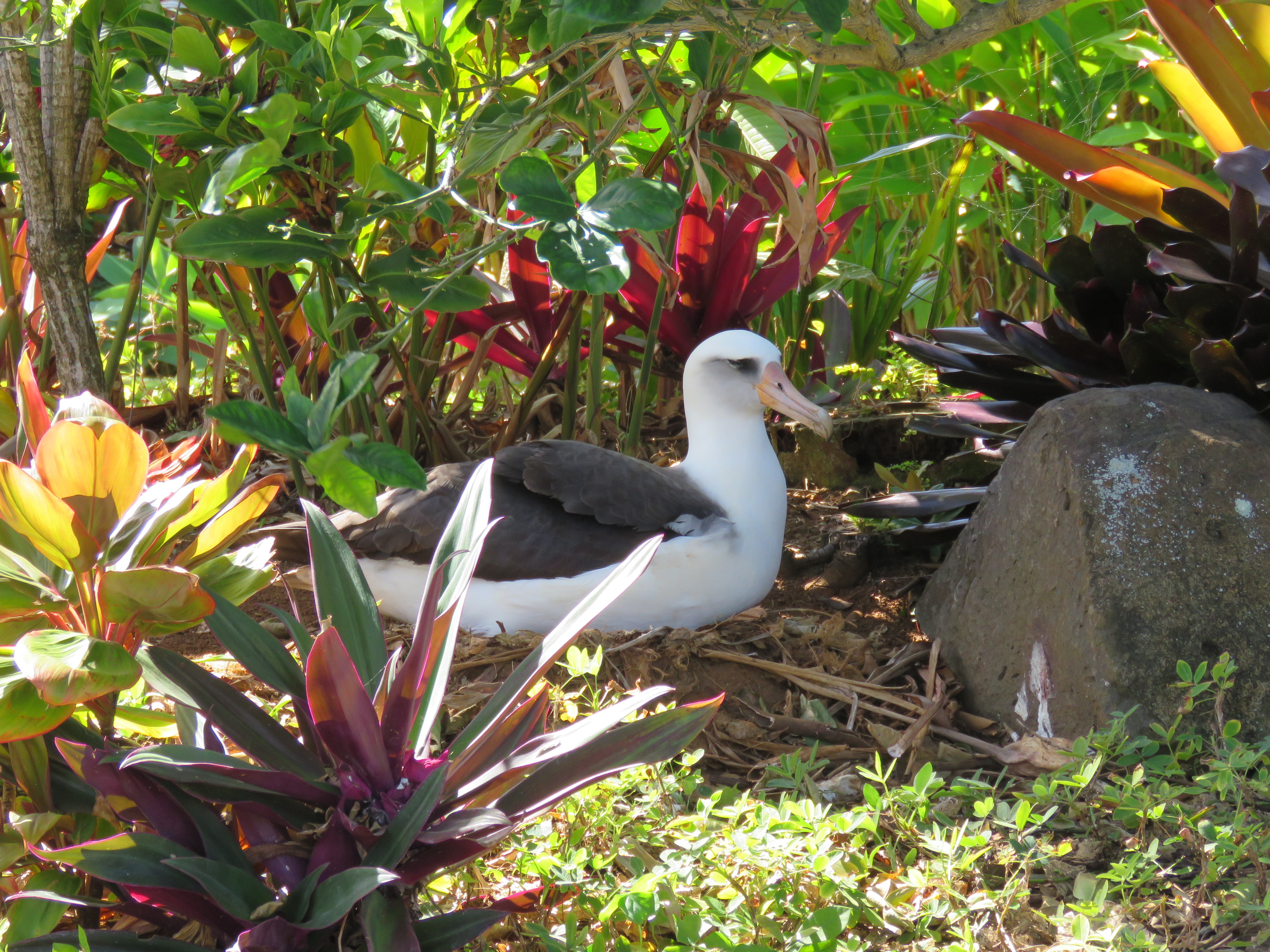
Nesting Laysan Albatross, Princeville

Nesting Laysan Albatross, Princeville

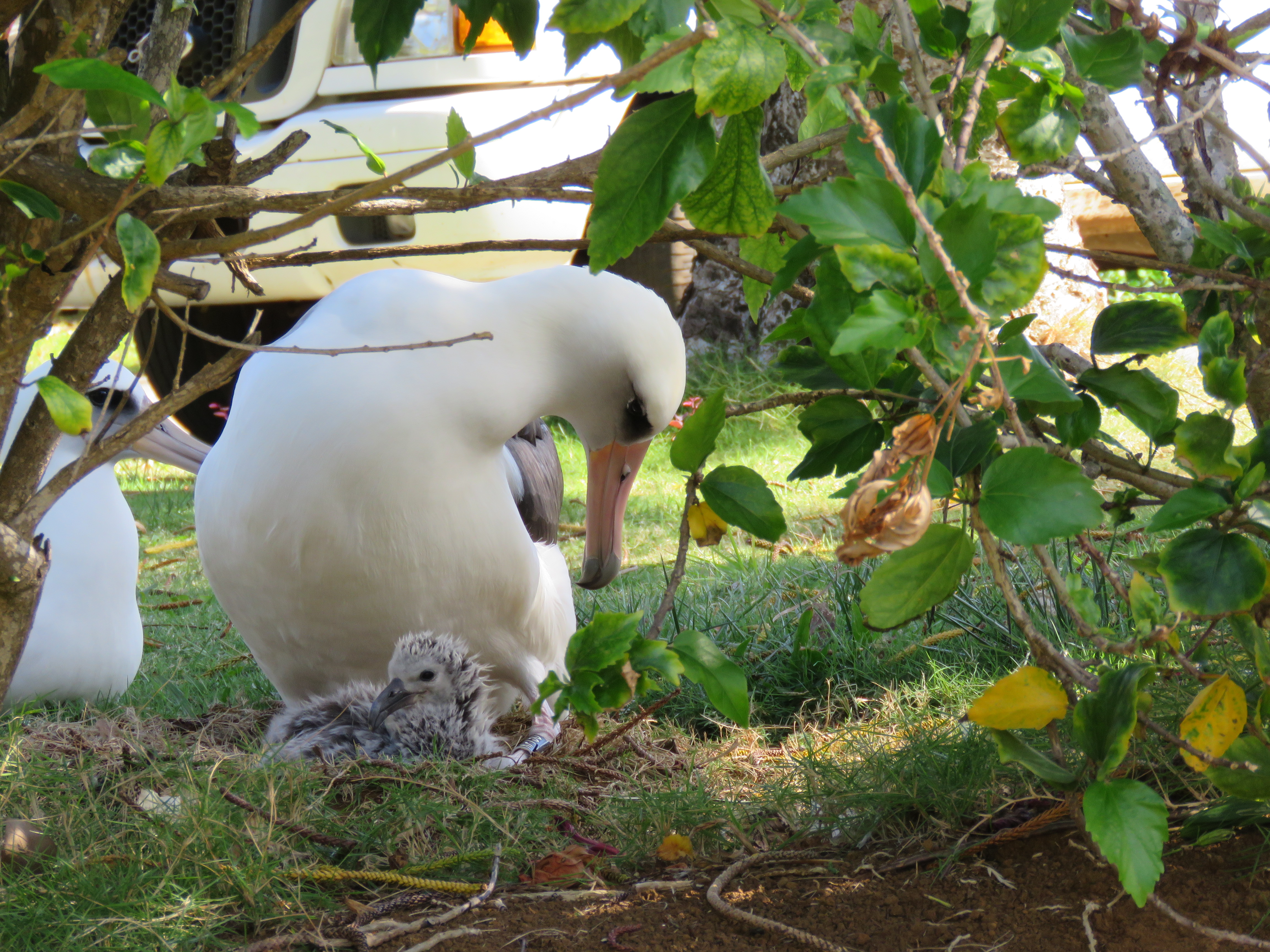
The chicks are grey and fluffy and super cute, in an albatross kind of way! The ones we saw were cared for/doted on so lovingly by their parents – it was very sweet. Sometimes a father or mother will refuse to get up off the nest and give the other parent a chance to dote on the egg or chick. Cathy was careful not to upset the birds too much but needed to make note of each nester’s band number.
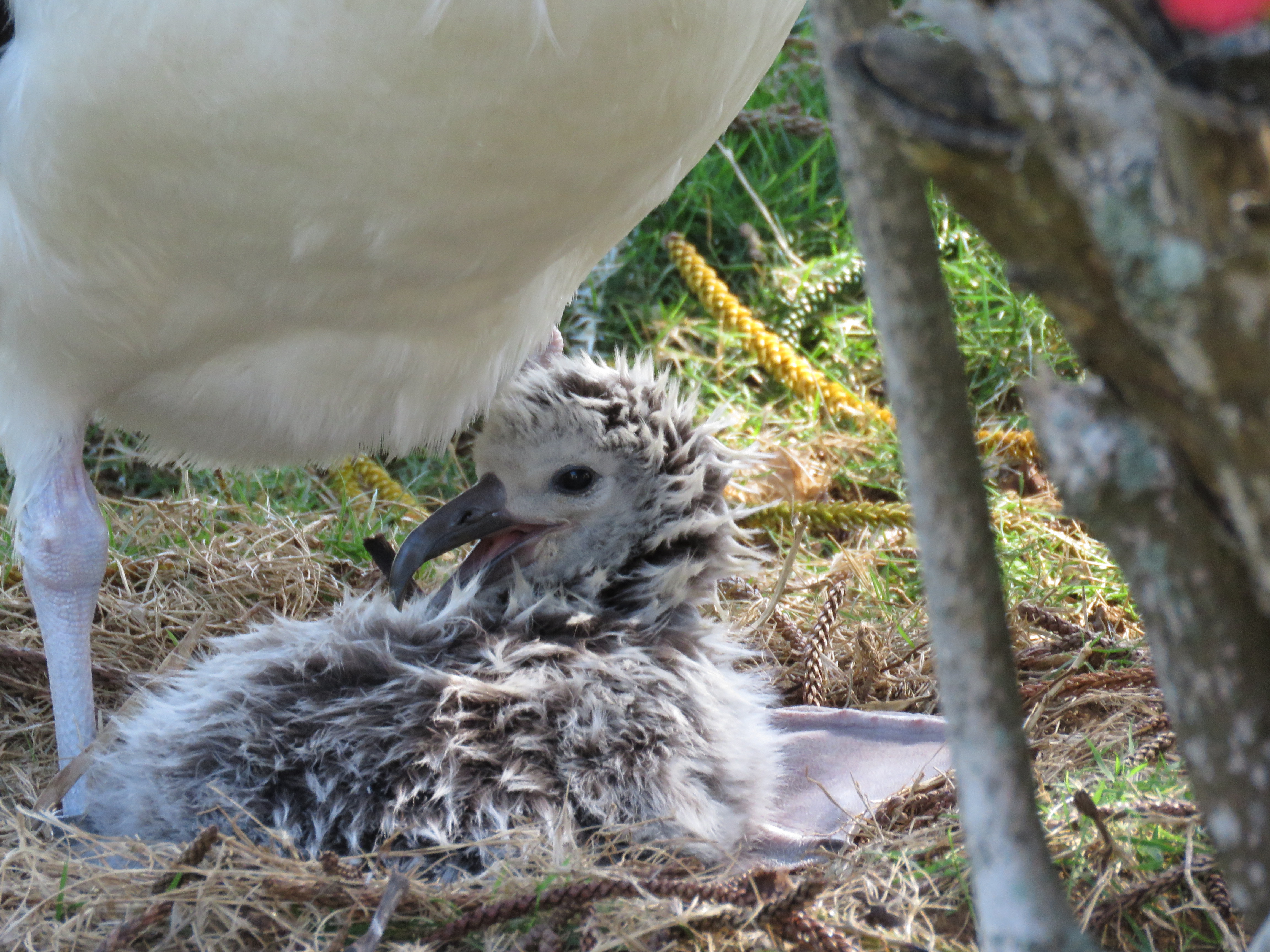
Laysan Albatross Day-old Chick
Laysan Albatross Day-old Chick

Laysan Albatross and Parent, Princeville

Laysan Albatross Chick and Parent, Princeville

During their nine-month process from courting to fledging, albatrosses kind of define this Princeville neighborhood. It was nice to see that Cathy’s neighbors were looking out for the birds and enjoying watching their progress. Sometimes people get to name birds that hatch in their yards.

On our walk, we got to see the cliff edge where the fledglings take off for their first flight. When we got home, I watched a video on Cathy’s site showing the numerous attempts that a particular juvenile “CJ” made before he took flight for the first time. It was very exciting. Since they are not able to get enough lift by running, like their parents do, the juveniles need a cliff edge where there is a breeze to provide the lift they need. Cathy told a story of one juvenile that didn’t quite get it right and ended up stranded in the ravine. She ended up climbing down a very steep edge in order to save the bird. It was so tired when she grabbed it that it didn’t resist her clutch at all. However, as soon as she got the bird to safety, it bit her. Oh well, all in a good day’s work protecting and saving wild and beautiful creatures!

Many thanks to Cathy for her important and valuable work and for editing this article for accuracy.
Milford Mind 2/8/15

So, we’re going to New Zealand. NZ is one of those places that I’ve seen pictures of many times and just marveled at the incredible beauty of its valleys, mountains and fiords. I remember seeing pictures and videos of New Zealand and being blown away. Upon hearing about how far away it was, I thought I’d never make it there in my lifetime. I figured the cost and distance were too much. Well, here we are, Bill and I are heading there in less than a week and it still seems surreal to me.

One of the things that is particularly unreal is this amazing adventure we have planned while in New Zealand – hiking the Milford Track. The Milford is a 33.5-mile trail that goes northwesterly from Queenstown to the Milford Sound at the coast. When Bill and I watched a video of this trek, the beauty of it brought tears to my eyes. Gorgeous valleys, steep, otherworldly cliffs, waterfalls and pristine rivers are its jewels. It’s a one-way trail that only 50 people per day are allowed to start. Tent camping is not allowed, you have to stay at designated cabins and lodges along the way. Many people do this trail with backpacks weighted with food, sleeping bag, clothes, and everything else needed for the four-day adventure. Bill and I knew that we were not up to backpacking at this point in our lives, so we signed up to do this trek with a guide company that will tell us about what we’re seeing along the way, feed us, as well as provide a hot shower and bed to sleep in.

I’m excited and also fearful about this most wonderful adventure we are going on. It will be a challenge to hike with a small pack for 8-13 miles for several days in a row. Bill and I have been doing hikes nearby with intent to build up our stamina and prepare for Milford. We’ve hiked a few times on the Wai Koa Loop Trail which is five miles long and winds through a beautiful mahogany plantation, community gardens, a dog park, an organic farm, lagoons and a beautiful garden. The loop trail is part of the Anaina Hou Community Park that also includes a farmers’ market, skate park, café, mini-golf and botanical gardens. The land was donated by the owners, Joan and Bill Porter – the latter being the founder of E-trade. Before or after hiking, sometimes we enjoy a round of mini-golf, which incorporates educational signs about Hawaiian plants, culture and agricultural practices at each hole.

The Milford Track is known for its very changeable weather and we’ve been told to prepare for everything – rain, flooding, sun, snow, and sandflies. Packing and otherwise preparing for this trek has been a bit of a challenge – being a worry-wart and all. When I’m able to tell my worrying mind to take a back seat, I’m able to visualize a challenging but fun and amazing trip through beautiful mountains, valleys and fiords. And if I’m lucky, I’ll lose my worrying mind somewhere along the way.

Na Pali, Take Two

On Tuesday 1/14 we put on our hiking shoes, packed water and snacks, and headed to one of the world’s most beautiful and treacherous hikes – the Kalalau Trail. To get to the trailhead, we went through Hanalei on the Kuhio Highway (not really a highway by New York standards!) and followed the road along the bay and north coast until it ended, literally. You cannot circumnavigate Kauai; the reason is the range of mountains (formerly volcanoes) that are part of the Hono’Onapali Natural Reserve area and Na Pali Coast. A series of connected natural reserves encompass approximately 40- 50% of the Island of Kauai. Because Na Pali’s cliffs go directly into the ocean, there is only a foot trail that will take you part of the way down the northwestern coast. Kalalau is 11 miles long, one way, and ends at Kalalau Beach. Along the way, hikers experience the most amazingly beautiful views, waterfalls and beaches – but it comes with a price.

IMG_0123

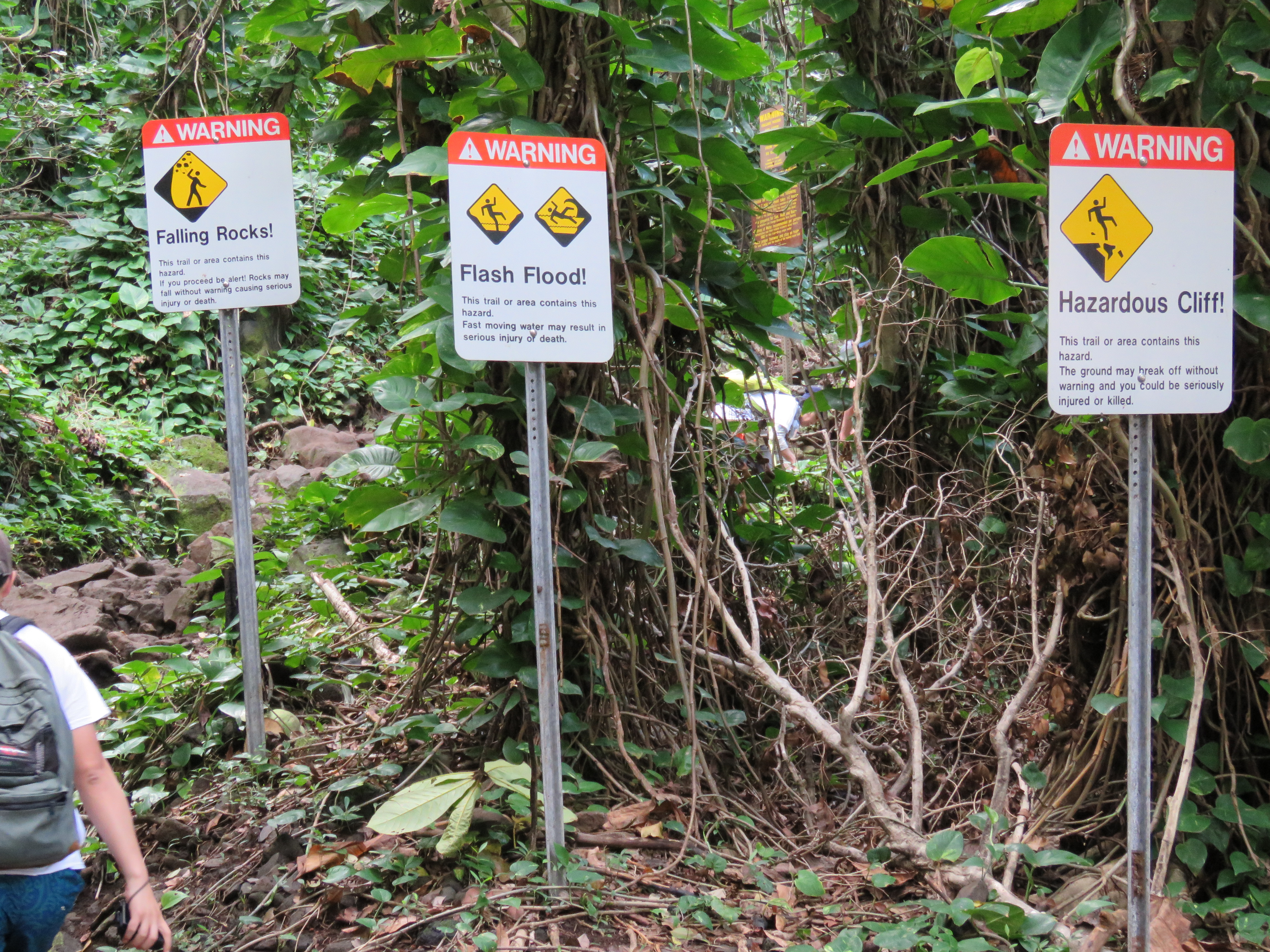
Warning signs at Kalalau Trail head!


Backpacker magazine calls the Kalalau one of America’s 10 most dangerous hikes, and for good reason. The trail winds along the side of mountains with 300’ cliffs that dump into the ocean. If heights don’t have an effect on you, the fact that the trail is rocky, crumbly and slippery might give you pause. Nevertheless, signs at the entry to the trail don’t seem to stop people from venturing on in flip-flops and looking otherwise completely unprepared for this kind of trek. Despite all of the opportunity for Kalalau hikers to unwittingly jettison themselves off of a cliff, there have been very few known fatalities on the trail itself. The much larger danger is associated with going in the water from the few, small beaches along the way – especially in winter. The surf can be seriously treacherous at times and over 100 people have lost their lives from being pulled out to sea while trying to cool down after a hot day on the trail.

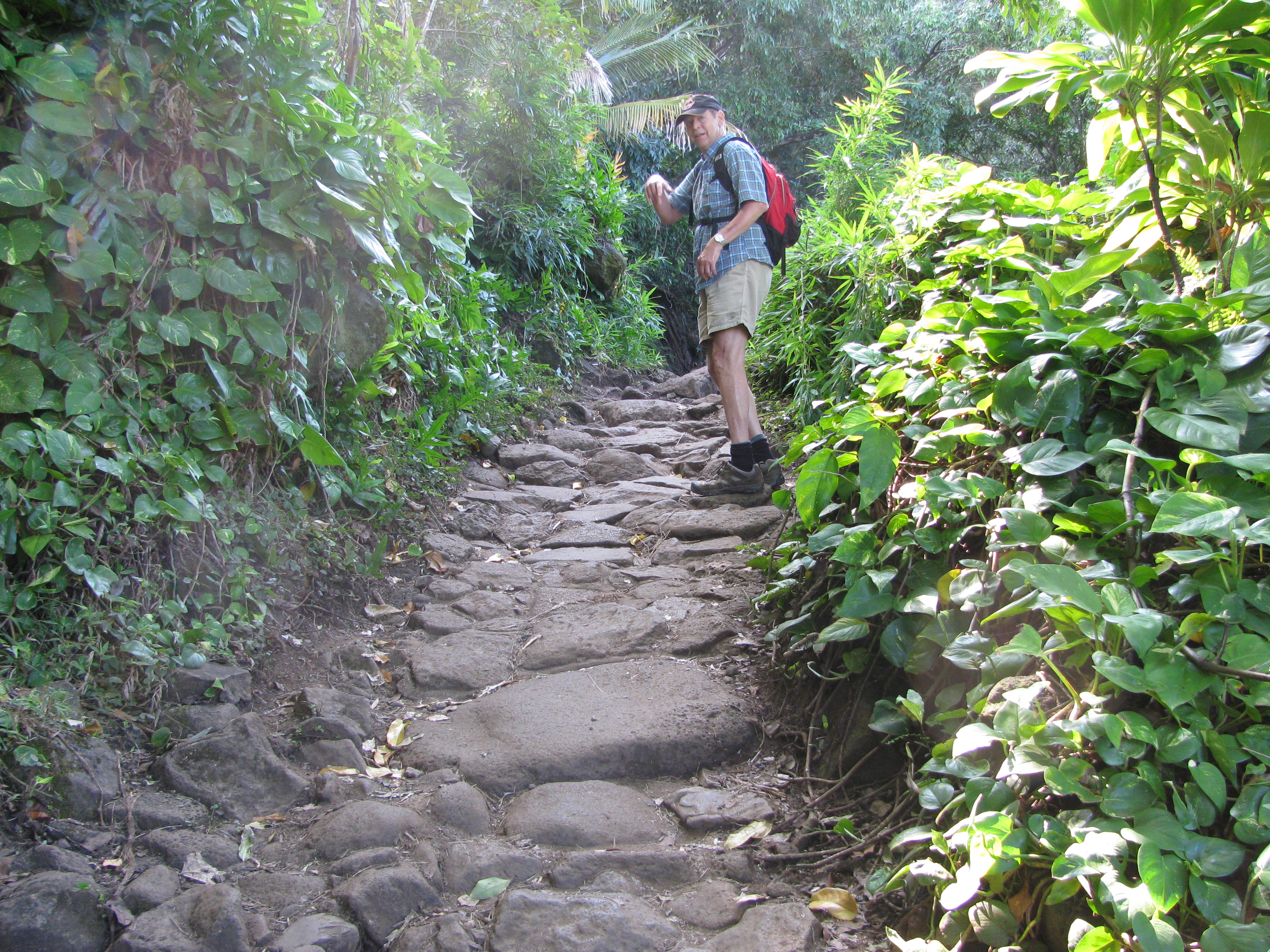
Despite all these warnings, we decided to make a short trek of it and just go the first 2 miles from Ke’e Beach to Hanakapi’ai Beach. I have to say, this is definitely the most rugged trail I have ever been on. Some of the trail is dirt, but a large portion of it is uneven, smooth rocks that get very slippery when wet, even with my aggressive-soled hiking shoes.

I had a few moments of thinking about my favorite trail back home – Treman State Park – which can get kind of squirrely in parts. I often find myself complaining about the lack of money that New York State has for maintaining its state parks. I found myself wishing for even a taste of something like the most wrangled trails back home! For me, every step had to be thought about carefully in order to avoid a twisted ankle, a slip, or a fall. To tell you the truth, it was kind of tiring and I had to take more than a few short breaks along the way.

IMG_1847

The Kalalau Trail


IMG_1863

Beautiful Na Pali Coast


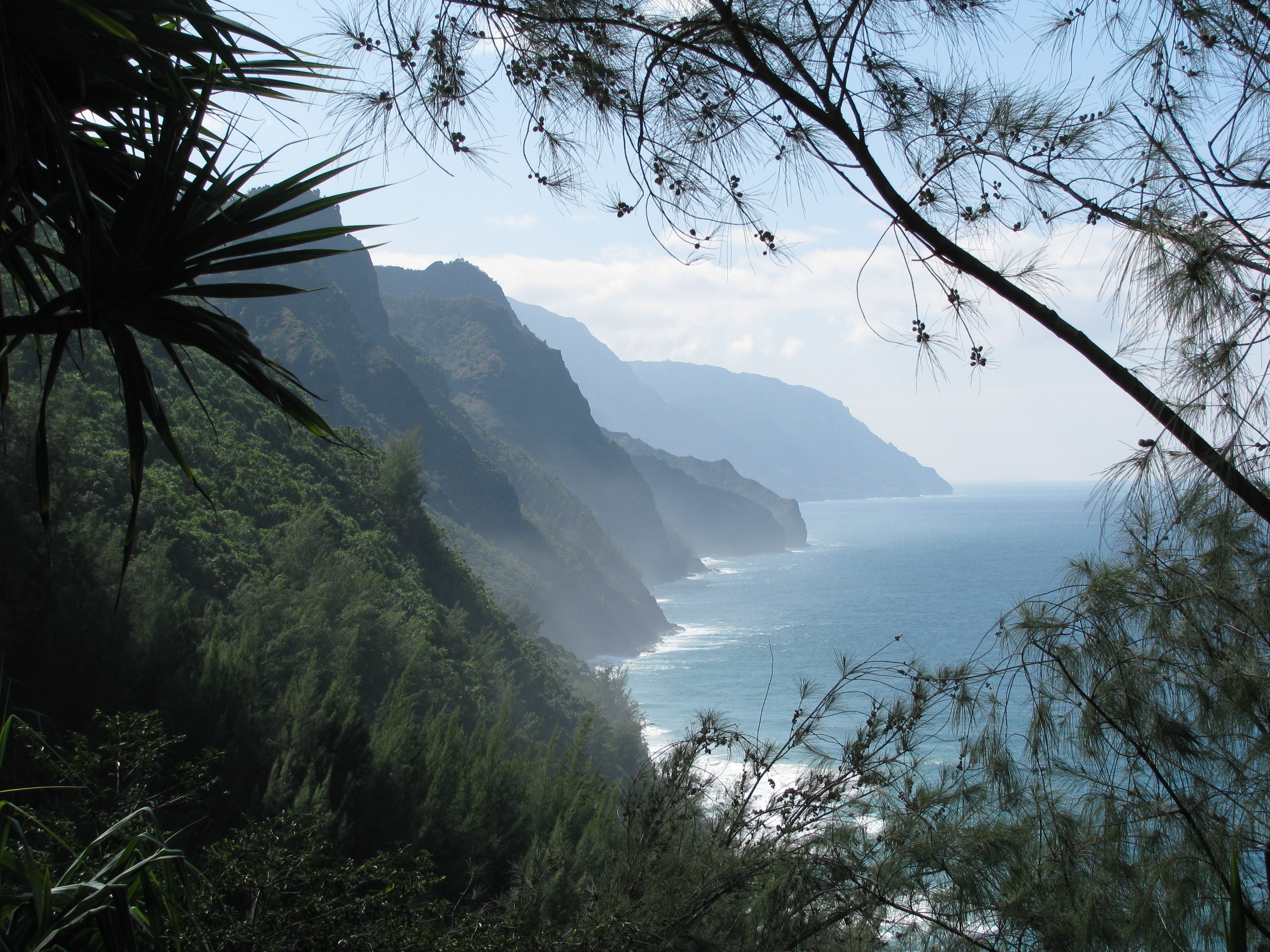
The views of the cliffs, the ocean and Ke’e Beach far below were so beautiful that it took my breath away time and again. I snapped a few pictures along the way but, just like when we took the catamaran cruise and viewed Na Pali from the water, photos just don’t give it justice. Looking up you see tall spires and peaks shooting up hundreds of feet. Looking down you see the terra cotta jagged cliffs that end on the rocky shore hundreds of feet below. From one vantage point, the trail widened and took a turn south and provided an incredible view down the Coast. On both the way out and back we found a few rocks to just sit and ponder this amazing place.

Hawaiians, who grew taro and other vegetables into the late 1800’s, inhabited several of the major valleys along the coast. They also created trails to link these settlements that are now part of the Kalalau. Since the early Hawaiians were expert sea navigators, they used canoes to access Na Pali’s remote valleys and to travel all over Polynesia.

So, some people were trekking along at a pretty good clip, and others, like me were taking it slower and with more caution. I noticed that it seemed the younger the hiker, the faster the pace! I guess getting older comes with a heightened weariness to falling. As well, being short has its positives and negatives in this kind of walk. Being 5’2”, I have a lower center of gravity, which adds to stability — and, I suppose I have less far to fall if I did. However, at 6’2”, Bill’s long legs definitely gave him an advantage on the steep drops and climbs. The whole time we were hiking, I felt very aware that there was a very steep and long drop just a foot or two off the narrow trail.

It seems like my confidence on the trail should have built over time, but instead, the further I went, the more anxious I got. A few tiny trips and slips on the rocks made my heart skip a beat and my adrenaline surge. At somewhere around ¾ of a mile, I realized that my shoulders were up somewhere around my ears and thought that perhaps I’d had enough for the day. Even though my body was perfectly capable of trekking on for several more miles, somehow my psyche was not. I remembered that this was not the first time I’ve had a reaction to high altitude and steep cliffs so I think it was good to call it a day.

As we headed back down to Ke’e Beach and revisited all of the beautiful vistas along the way, I reminded myself that we have time to come back on another day and go further on the trail. So I bid adieu to Na Pali and promised to come back for more of her splendor.

Paddling on a River of Flowers

On Monday 1/12/15 we had the opportunity to paddle with the Hanalei Canoe Club which was founded in 1973. The HCC has a long history of winning championship outrigger races and has competed in Tahiti, Australia, Western Samoa, California, New York and Thailand. In 1993, HCC built its current clubhouse near Hanalei Beach after the previous one was destroyed by Hurricane Iniki the year before. Forty-two years since its founding, the Hanalei Canoe Club has approximately 200 members is thriving with four divisions including youth, women and men’s competitive teams, and the recreational division that paddles year-round. The Club’s recreation paddlers go out on Mondays and Fridays at 10:00 this time of year and head up the Hanalei River about 2.5 miles, just beyond the one-way bridge into town.

Bill and I were excited to paddle on the Hanalei River because we were enchanted by it the first time we stood on its banks. The first night we arrived, we headed down to Hanalei from Princeville, and dined at the Hanalei Dolphin Restaurant, which sits on the River. Since it didn’t open for dinner for another half hour, we ordered a glass of wine and sat by the water. The first thing we noticed about the Hanalei is that it had beautiful orange flower blossoms strewn across its surface, dropped there by the trees that lined its banks. It turns out that the flower we saw is a type of hibiscus (hibiscus tiliaceus) or hau flowers, as the locals call them. It has five creped petals that are yellow at first and then turn orange as they open and develop. It was dreamlike to see them floating down the river that evening and even more dreamlike to paddle through them in an outrigger.

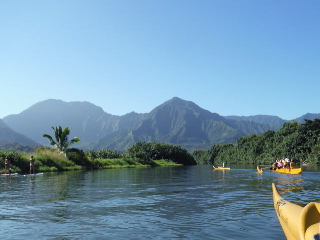
The paddle was made even more spectacular because of the amazing views of the mountains along the way. As we meandered upstream, each turn of the canoe revealed a new and beautiful vista. The boat I was in glided along and I soaked up all of the beauty along the way. Gratefully, the paddler in front of me, Louise Barnfield had a camera and was busy snapping pictures each time we paused for a quick break. I asked if she would share some with me and she did…

Paddling with HCC #1; Photo by Louise Barnfield

Paddling with HCC; Photos by Louise Barnfield

DSCF1980  DSCF1968 DSCF2032

We’re looking forward to more great paddles with the HCC and in OC1s in the weeks ahead.

Na Pali Bound 1/5/15

On Monday 1/5/15 we took a 2.5 hour boat cruise with Holo Holo Charters on a 65’ catamaran and saw amazing sights. It left from Port Allen, about 10 miles west of Poipu along the southern coast of Kauai.

That day, the surf along the southern coast was calm and easy, great for whale watching, but the group was psyched to see the Na Pali Coast up the north-western side of the island which came with significantly more wind and waves. The captain gave the passengers the option to avoid the rough seas and stay closer to home but we chose to see the Na Pali Coast instead.

Just as the captain said, the waves were pretty easy at first and we were able to stop a few times to enjoy playful dolphins and breeching whales. Then the captain told us to hunker down in the boat for the 30-minute ride up the coast. He said the speed, wind and waves would be too much for anyone to stand or sit at the bow of the boat and he was right. We cut through the 8’ swells at about 20-25 mph directly into the wind. It was pretty exciting but, perhaps a bit too exciting for my stomach. Having experienced seasickness once before, I knew I needed to do something quickly before I turned completely green. At the encouragement of the crew, I moved to the center of the back of the boat, where they said I would get some fresher air and experience the least amount of boat movement. After focusing on my breathing and closing my eyes for a while, I felt my head clear and my stomach settle down. About 20 minutes later, Bill and I slowly watched the Na Pali Coast come into view.

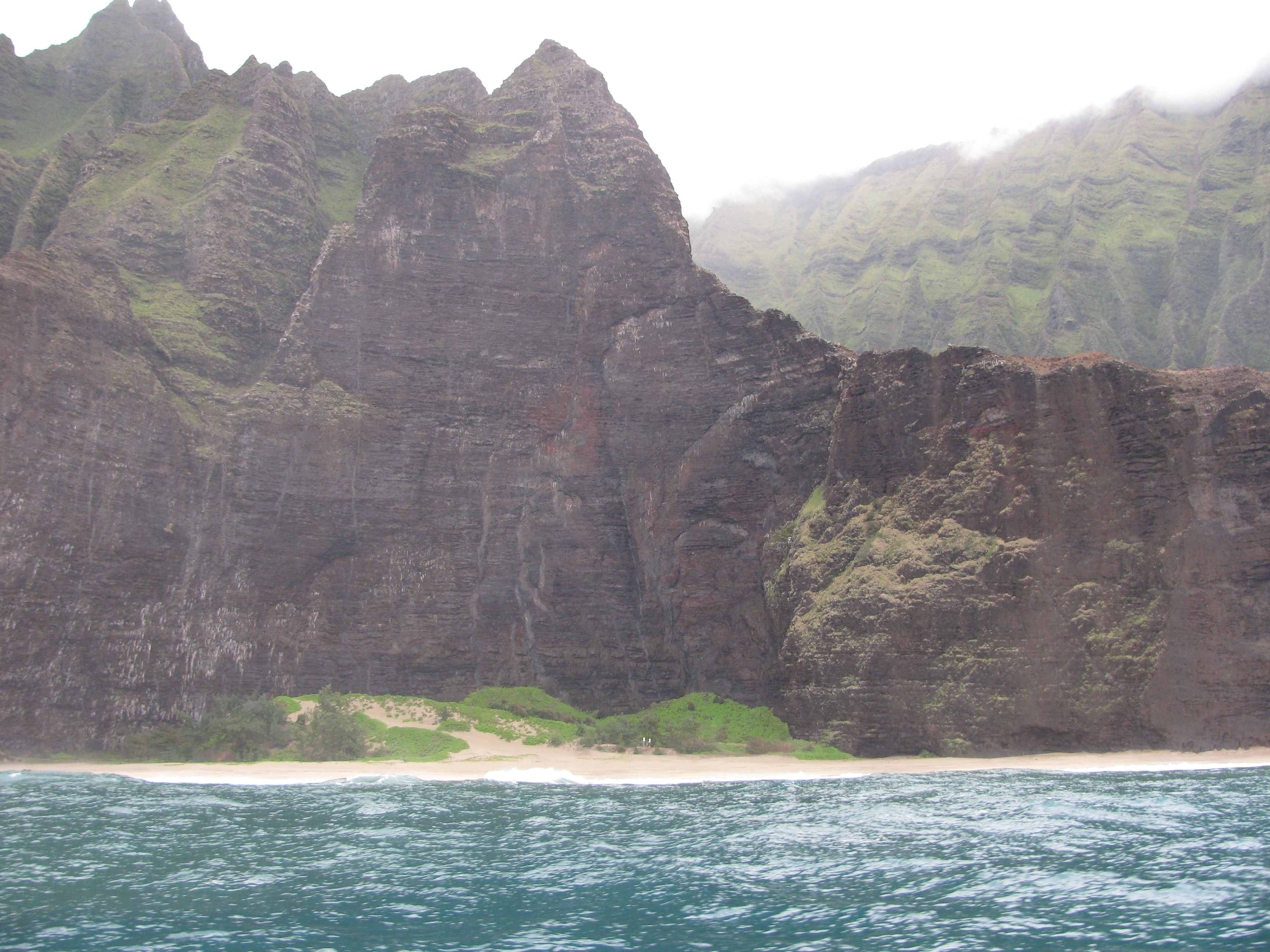
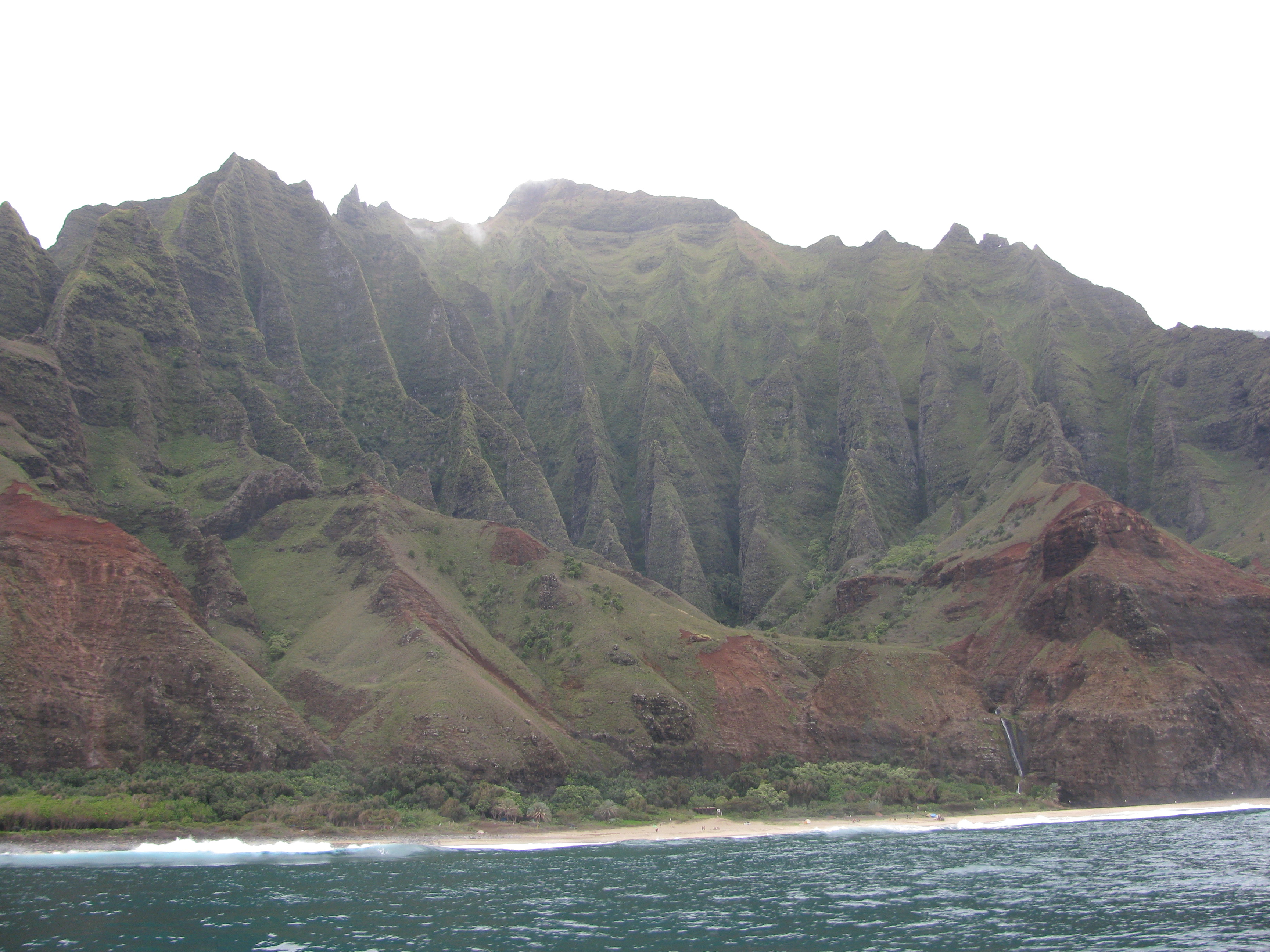
The Na Pali coast is one of those places where photos just don’t give justice to the real thing. I’ve had this experience many times before in nature. I’ve seen the most beautiful views of The Grand Canyon, Lake Placid, Robert Treman Park, Yellowstone and others. So many times I took photos to remember these beautiful places, but they don’t come close to the actual experience of being there. Kauai’s Na Pali Coast is one of those places you have to just experience. Nevertheless, I’ll include a few pictures here to give you a sense of this amazing place!

IMG_1763 IMG_1759

The island of Kauai, like the other Hawaiian Islands, was created by underwater volcanoes millions of years ago. Kauai is the oldest of the large islands in the chain and has the most rain, soil and plant life. What were once volcanoes now look like tall spires of green, lush mountains due to huge amounts of rainfall. Further inland, the wettest place on the planet is found on Mt. Wai’ale’ale at 5,075 feet with an average of 374 inches of rain per year. All that rain creates beautiful waterfalls and rivers that cut huge canyons in the porous rock, leaving tall fingers of cliffs that are nothing less than awe-inspiring. As you travel north up the Na Pali, the cliffs and peaks rise right out of the sea going from 1,000 to 4,000 feet. You see views that you don’t think could get any more beautiful and then comes another.

Along our trip, we viewed a few remote and beautiful beaches with a few hearty souls on them. This area of the island is so rugged, that the only way to get there is by hiking in or arriving by boat or helicopter. The 11-mile Kalalau Trail starts at the north coast of the island and winds its way along the cliffs to view remote waterfalls and beaches. The conditions are often dangerous, especially in winter when the big surf arrives. Many a hiker, boater and camper have lost their lives by not heeding warnings or being aware of quickly changing conditions.

Parts of many movies including,King Kong, Jurassic Park, South Pacific and Raiders of the Lost Ark were filmed here to take advantage of its dramatic gifts. The Na Pali Coast is the most beautiful place I have ever had the good fortune to enjoy on our beautiful planet.

And then the sky cleared

Our first day on Kauai was windy, overcast and rainy. It was a chilly day, for Kauai anyway, hovering in the upper 60s. I’m sure my friends and family back home are smirking as they read this because they’re experiencing temperatures in the 20s right now. However, this weather was a blessing because we were so out of it from traveling that we weren’t able to do much anyway. A warm sunny day would have lured us out of our room sooner to do hiking or paddling but I think we really needed to just recover. We did make it to a grocery store to get breakfast food, snacks and beverages though. While we were out, we also drove west along the coast to check out a blowhole at the Spouting Horn site. Blowholes occur sporadically around the islands where ocean water is forced into ancient lava tubes and shoots up into the air with a big “whoosh” sound. They’re pretty cool to watch and can send the water up 30 feet sometimes. It was a great day to see Spouting Horn because the ocean was rough with big crashing waves.

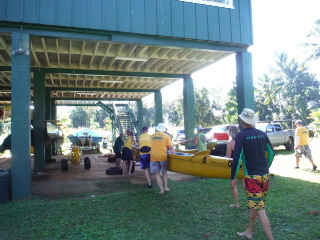
While driving towards Spouting Horn, the sight of OC6s (6 person outrigger canoes) caught our eye. We turned the car around and headed back to a small park and harbor where the local outrigger canoe club was quickly securing their canoes from the wind. The canoes were being stored for a few months for the winter without their amas and iakos attached. This leaves the canoes in a vulnerable state; evidently it was windy enough that one of them rolled half way across the park. We (mostly Bill) helped them get their boat moved and secured. It was nice to meet some fellow paddlers. This time of year in Hawaii is considered “OC1 season” where the temperature is a bit cooler and the waves and wind get intense at times. The outrigger clubs take a break with their OC6’s for a few months and those who have the means and ambition, focus on their OC1 skills.

We woke the next day to puffy clouds, blue sky and the sun. After being under Ithaca’s cold and grey skies, seeing the sun felt a bit surreal but we could feel the fog lifting in our bodies and minds. On Saturday, we explored the grounds of the hotel and found that the Grand Hyatt Kauai definitely lives up to its name. The grounds are beautifully manicured with flowers, palm trees and flowing water. It’s much like the other places we’ve stayed in Hawaii for the HICSS conferences. Gorgeous views, lots of fun water slides and pools, restaurants and shops. It’s like a small, self-contained village, only it’s not. These places are built to be pleasing and comfortable but, of course, they all have a Disney-like, non-reality feel to them. Nevertheless, why look a gift horse in the mouth, especially when someone else is paying for it!

Since there aren’t places to rent OC1s around here, we decided to rent the sit-on-top kayaks and paddle around (and around) the hotel’s small lagoon to move our bodies a bit. It wasn’t much of a work out but we had fun. After that, we went for a walk eastward up the beach to a place called Shipwreck Point, which gave gorgeous views of the blue crashing waves and dramatic lava cliffs.

Later that day, we took a tour of the Allerton and McBryde Gardens which are part of the National Tropical Botanical Gardens http://www.ntbg.org. This was a lot of fun and very interesting. The Gardens lie in the Lawa’i Valley and was first transformed by the Hawaiian Queen Emma. Later on, Allerton Garden was developed by noted landscape artist Robert Allerton and his partner, John Gregg, architect. With five “rooms” consisting entirely of trees, exotic plants, grasses, statues, water features and other structures, it is itself art. Instead of painting his garden canvas with colors from flowers, he painted with texture, hue, movement and sound, giving the observer the experience of being in and part of his artwork.

Chickens on the Beach

The Red Jungle Foul or Moa can be found all over the Island of Kauai. It was the first bird brought here by the ancient Polynesians that inhabited these islands long before Captain Cook stumbled upon them. Today, there are two species of chicken or jungle foul that are abundant on Kauai. The actual Red Jungle Foul is found in the upland forests and meadows and is often confused with its lowland cousin, the domestic chicken.

Female wild lowland chicken

Female wild lowland chicken

IMG_0249

Male lowland chicken

We’ve been watching and hearing the wild, domestic chicken today. Their colors are varied and quite beautiful, probably due to interbreeding with the Red Jungle Foul. The females are often brown and white and have such large, flat and horizontal tails that sometimes it’s difficult to determine which end of the bird you are looking at! Most of the males seem to have brown and black bodies with long black tail feathers that swish when they walk. One of the males we just saw had a big beautiful showy white tail and seemed to be pretty popular with the gals around him.

The strangest part of watching these birds is seeing them on the beach. In upstate New York, you often see chickens in people’s yards, pecking around for bugs. These birds are providing eggs for their owners or fattening up to become a meal. The owners keep them close to home by feeding them and providing a safe home at night. To see this same bird wild and on the beach is a real treat. These birds are acting as they have for presumably thousands of years, before they became domesticated. They have very few, if any predators here on Kauai and can live in peace.

Landed on the Garden Island

Our first day of 2015 was another day of travel and transition but we finally landed at the hotel in Poipu on the Garden Island of Kauai. Before we left yesterday, we were hoping to take in some sights in Honolulu but found that the beautiful Iolani Palace was closed for the holiday, so we had the cab driver take us to a place that we knew would be open — the mall. Now, this was certainly not our first choice of places to visit in the wonderful state of Hawaii, but we only had about an hour to shoot and we needed a few things that would probably be difficult to locate on Kauai, so, we shopped. The Ala Moana mall was pretty upscale and located near the Japanese section of the city. It was abound with Asian people and nearly everything was translated into Japanese. Bill said that, having traveled to Japan, the whole place had a Japanese feel to its design.

Our flight from Honolulu to Lihue was pretty uneventful except for the joy of feeding a few spotted and zebra doves in the airport while waiting for our flight. Like most buildings in Hawaii, parts of the airport were open air and others weren’t, so birds are a common sight everywhere you go. For us northerners, the first time you see a feathered friend in a building is a bit startling but it becomes commonplace pretty quickly.

After renting our car and seeing a beautiful rainbow, we enjoyed seeing more birds along the way to the hotel including many wild chickens and several cattle egrets. The hotel is a huge place and, gratefully, our room is as far away from the commotion of hotel life as it can get. We’re at the end of a very long hallway near a natural area and the public beach. This will be a great place to watch birds, look at the Pacific, and listen to the waves.

I went to bed at about 8:30 last night (still adjusting to the time change) and was awakened at about 12:30 to the sound of jungle foul doing their “cock a doodle doo” call. I slept well but woke up several times and heard them continuing their wooings. Evidently, the critters call out all night long, presumably trying to attract a mate or marking their territory. I’m glad they didn’t keep me awake. The sound of the waves crashing on the beach was truly wonderful and lulled me back to sleep each time I woke.